QR delivered by email in under 3 minutes. Install before you travel, activate when you land.
Destination guide
Last updated: June 15, 2026Africa’s cultural powerhouse — Afrobeats, Nollywood, endless energy — but also the corridor destination that demands the most preparation. Visa, yellow fever and region-by-region safety: here is the essential, verified.
Travel essentials
European and Angolan citizens need a visa or eVisa, obtained BEFORE travelling (eVisa portals have frequent downtime — apply weeks ahead). ECOWAS citizens enter visa-free for up to 90 days. Note: yellow fever is an entry requirement (see Health).
| Passport | Entry rule | Max stay |
|---|
| Portugal · Spain · France · United Kingdom | Visa / eVisa required (obtain before travel) | — |
| Cabo Verde · Guinea-Bissau · Ghana · Senegal | Visa-free — ECOWAS free movement | 90 days |
| Angola | Visa / eVisa required (Angola is not in ECOWAS) | — |
⚠️ Border rules change without notice. Always confirm with the official source (consulate, immigration, travel.state.gov, gov.uk, Portal das Comunidades) before travelling.
Health
A yellow fever certificate (ICVP) is MANDATORY to enter and leave Nigeria — present it on arrival. Get vaccinated at least 10 days ahead. Exempt: infants under 9 months and adults over 60. The electronic e-Yellow Card is now used at all entry points.
Passport
Passport valid for at least 6 months beyond the date of arrival, with blank pages.
To confirm (not published as fact):
- Eligibility, fees and route (eVisa vs visa-on-arrival) change often and can exceed USD 200 — confirm with the Nigeria Immigration Service at the time of travel.
Arrival & Safety
Airport
Main gateways: Murtala Muhammed International Airport (LOS, Lagos) and Nnamdi Azikiwe International Airport (ABV, Abuja). Expect multiple checkpoints on arrival.
Getting in
Uber and Bolt operate large fleets in Lagos and Abuja and are the safest, most reliable way to get around — use the apps rather than street taxis, especially at night, and ignore touts in the terminal.
Safety
Level 3 — Reconsider Travel (US, 2026); several states at Level 4A blanket Level 3 advisory for crime, terrorism, kidnapping and instability (in April 2026 the US drew down embassy staff). DO NOT TRAVEL (Level 4) to Borno, Yobe, Kogi, northern Adamawa, Plateau, Jigawa, Kwara, Niger and Taraba. Lagos and Abuja require heightened caution. Avoid road travel at night; arrange domestic travel with reliable operators.
⚠️ Border rules change without notice. Always confirm with the official source (consulate, immigration, travel.state.gov, gov.uk, Portal das Comunidades) before travelling.
Money
Currency: Nigerian naira (NGN), highly volatile. Cash dominates daily life; cards work in mid/high-end hotels and malls. Use ATMs in safe locations (banks, malls) and check your bank’s limits.
Connectivity
MTN (the largest), Airtel, Glo (Globacom) and 9mobile. Good 4G in Lagos, Abuja and most urban areas. A local SIM requires NIN (National Identification Number) registration — a barrier for visitors. The Verde Wave eSIM skips the NIN: you’re connected the moment you land.
Mandatory SIM-to-NIN registration is hard without local residency. That’s why an eSIM is so practical here: instant data, no local paperwork.
WhatsApp, VoIP and social media work well in Lagos and Abuja. Throttling can occur during congestion peaks or power outages. Temporary network restrictions have happened during political tension — check close to your date.
See eSIM plans →Sending money Nigeria
Sending money to Nigeria is part of diaspora life. The usual options: bank transfer (slower and sometimes with hidden FX margins), specialist apps like Wise, Remitly and WorldRemit (fast and transparent on fees), and cash pickup via Western Union or MoneyGram. In Nigeria, money can reach a bank account in naira, a mobile wallet or cash pickup; mind the volatility of the naira (NGN) exchange rate. Always compare the total cost — fee plus exchange-rate margin — and the speed before sending. Verde Wave never handles money; we just point you to the tools.
Sending boxes / cargo Nigeria
Sending boxes, barrels or drums to Nigeria is a deep-rooted diaspora tradition — food, clothes, electronics and gifts for family. Shipping is almost always by sea (cheaper but slow — typically several weeks to a couple of months), with an air option (faster, pricier) for urgent items. The essentials: make a packing list with values for customs, clearly identify sender and recipient with a local contact, and check import duties — used personal effects may have allowances, but new or bulk goods are taxed. For Nigeria, customs clearance can be slow and duties vary; many opt for door-to-door services that handle clearance. Declare the contents honestly, avoid prohibited or poorly protected perishable items, and keep your receipts. Compare freight forwarders on reputation and insurance, not just price.
Message us on WhatsApp if you need a hand.
Practical tips
Best time
The dry season (November to March) is the most comfortable, avoiding the rainy-season floods — but it brings the dry, dusty Harmattan winds.
Languages
English is the official language, used in business and administration. Nigerian Pidgin is the true street-level lingua franca, alongside Yoruba, Igbo and Hausa depending on the region. See the phrasebook →
Etiquette
Personal relationships and respect for hierarchy and elders matter greatly — greet formally. Arrive well presented to meetings. Avoid debating politics or religion in sensitive settings.
What to see & culture
Places
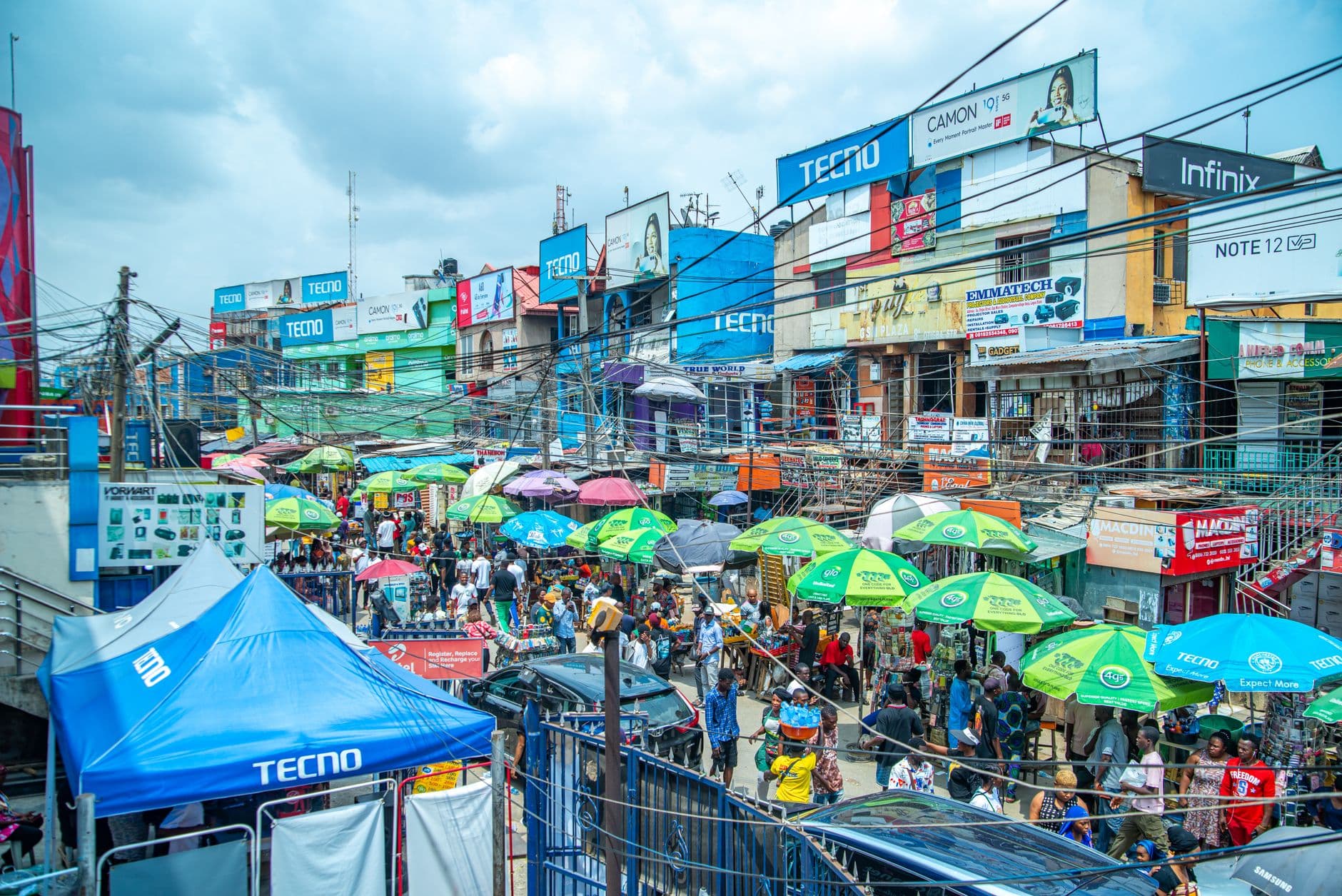
Lagos — beaches, markets (Balogun), art and the Lekki Conservation Centre with its canopy walkway. Abuja — Zuma Rock, Aso Rock and the national mosque. And Yankari National Park, with elephants and the Wikki Warm Springs.
Culture
Nigeria is the epicentre of Afrobeats and Nollywood, Africa’s largest film industry. The legacy of Fela Kuti, the afrobeat pioneer and voice of dissent, remains a touchstone of national identity.
Food
Jollof rice — in affectionate rivalry with Ghana — suya (well-spiced grilled skewers) and pounded yam with egusi soup are iconic. Easy to find in Lagos and Abuja.
Sources
- US State Department — Nigeria Travel Advisory (Nível 3; estados em Nível 4)
- UK FCDO — Nigeria foreign travel advice
- NaTHNaC / TravelHealthPro — Nigeria (febre-amarela, ICVP)
- Nigeria Immigration Service — vistos / eVisa
- ECOWAS / CEDEAO — Protocolo de Livre Circulação